Gunnar Askeland Filmed One Puddle for Ten Years. It Drifted Four Metres.
Behind a Bergen bakery, a video artist has recorded forty seconds of water every morning since 2016. At eight on a wet November day he tells Karin Hellberg-Yusuf the puddle was never the same one.
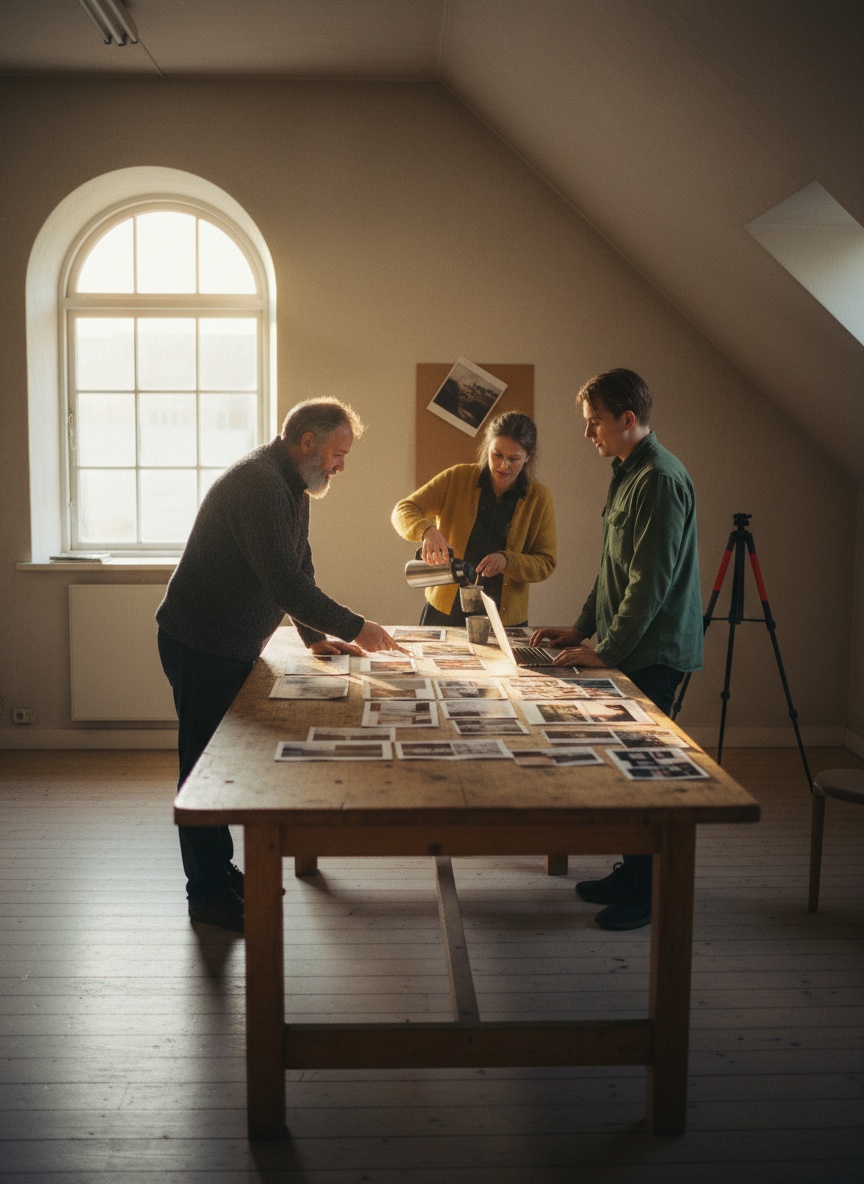
At 07:10 he does it the way he has done it more than three thousand six hundred times. Tripod down, legs spread over the cobbles, a count of forty, and then he is a man in a wet jacket again. At eight he sets up a second time, for me. "This one doesn't count," Gunnar Askeland says. "It's for company."
The courtyard behind the Fjeldstad bakery is small and tilted and smells of cardamom from the extractor fan. A delivery van is parked half across it. Askeland waits for the van to leave with the patience of a man who has waited for a lot of vans.
He is sixty-one. His tripod has one leg wrapped in red electrical tape. His thermos has a dent he calls a landmark. Since October 2016 he has missed four mornings, and he can tell you what he was doing on each of them, which is a kind of devotion I find hard to tease and slightly easy to envy.
The puddle sits in front of us now, brown at the edges, grey in the middle. It is about the size of a doormat. He looks at it for a while.
"It was never the same one," he says.
I ask what he means. He says the water is different every morning, obviously, and he knew that in the first week. That part he made peace with. What he thought he could keep was the dip. The low place in the stones where the rain collects, by the drainpipe, under the window with the geraniums. In spring 2019 the landlord had the yard relaid. The stones went down again a little differently. The low place walked four metres toward the bakery door, and Askeland walked after it with the tripod.
"I told myself it was the same puddle in a new coat," he says. "Then I stopped telling myself."
He has not stopped filming. That is the part I cannot get over. He just stopped pretending.
We watch the first morning on his phone, under the bakery awning, rain ticking on the plastic. October 2016. The water is dark and the frame is a little crooked. On the far side of the yard stands a three-storey wooden annex with blue shutters, and its whole face lies in the puddle, shutters and all. A washing line crosses it. One white shirt moves in the wind for forty seconds, and nothing else happens.
The annex came down in March 2019 to make room for flats. There is a clip from the week before, the shutters already off, the windows black. He does not skip it. He says he watches it about once a year, on the day he thinks it fell.
After the annex came a yellow crane, which stood in the water for fourteen months and turned its arm slowly through the clouds. After the crane came the brick chimney of the old boiler house, thin and orange, wobbling in every breath of wind. It was pulled down in 2023. Then a lime tree, cut in 2024 because of its roots. I watched it lose its leaves in the puddle three times in a row on his phone, and then it was a stump and then it was gone.
The puddle holds a new building now, a block with glass balconies. The water is kind to it. It breaks the block into green and silver squares and lets the sky through the gaps. Askeland says he has grown fond of it, and he says this the way people say it about a lodger.
He keeps a log, one line a day. Most entries are weather. On 11 September 2021 the whole entry reads "Water." It was the one morning, he says, when there was only a puddle in the yard, with nothing in it to remember and nothing to lose. He is oddly proud of that day.
The clip people ask for is a different one. On 8 August 2022 the sky went pink and the puddle turned the colour of the inside of a shell. It has been shown at three festivals and printed on a tote bag he did not approve. He dislikes it. "It's a sunset," he says. "Anyone can have a sunset."
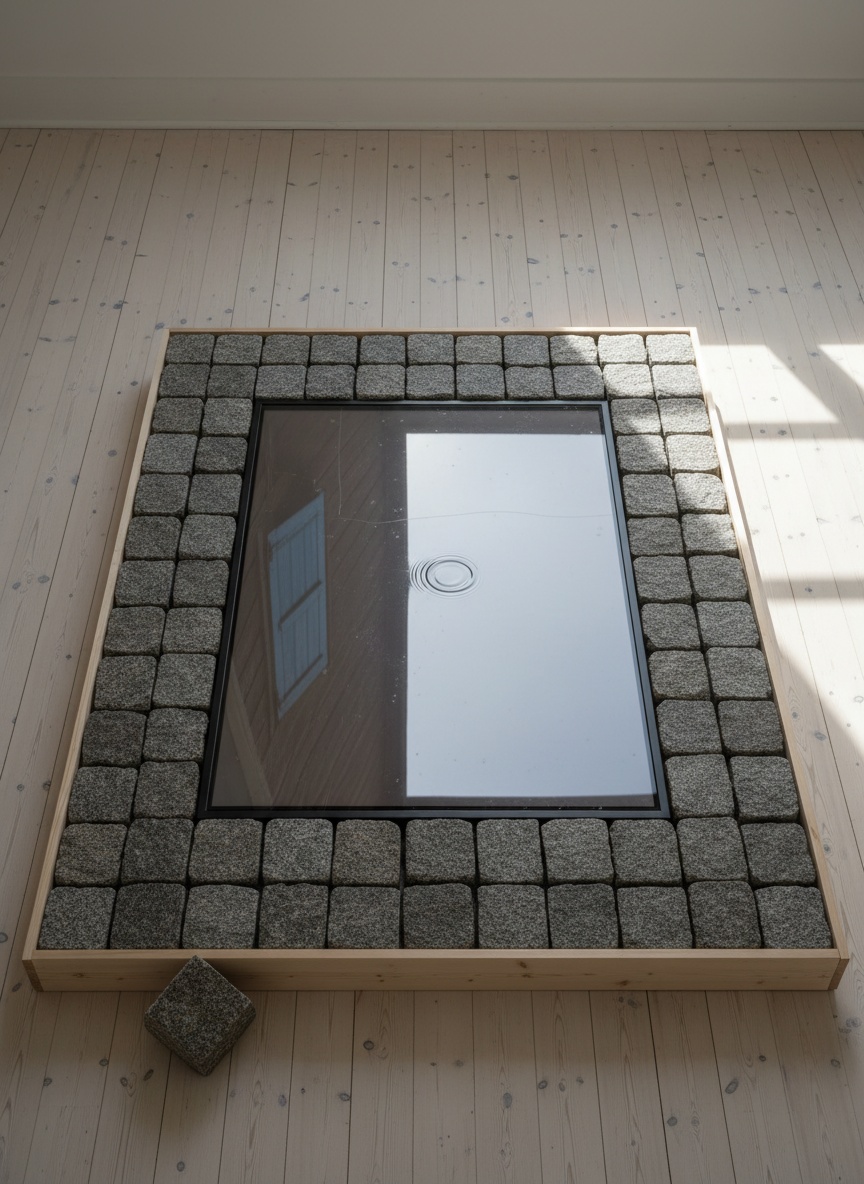
The work itself is called Forty Seconds, Bakery Yard. Its best version is in his studio loft on Nordnes, up four flights of narrow stairs. A flat screen, 1.4 metres by 0.8, is set face up into a bed of real granite setts on a pale pine floor, so that the film lies among the stones like water that has settled there. It plays the forty seconds on a loop. On the day I visit it shows a grey morning, a strip of wooden gable with a blue shutter at the edge, and a single drip making rings. One sett near the corner has come loose and sits crooked. A thin hair of dust lies across the glass. He will not fix either. Visitors, he says, step around the screen without being told.
Back in the courtyard the second forty seconds finish. The red light on the camera goes out. He does not look at the screen. He looks at the puddle, and the puddle looks like it always does, which is like whatever is above it.
A woman comes out of the bakery with a tray of buns for the van that never came. She steps around the water and around us. "Still at it?" she says.
"Still at it," says Askeland.
"Same puddle?"
He thinks about it. Rain beads along the tape on his tripod.
"Near enough," he says, and he holds the thermos out to me.