A Locked Door on Lübbener Straße and 140 Envelopes Nobody Sent
On Saturdays Mei-Ling Ostrowski's gallery in Kreuzberg stays shut. Inside, she addresses invitations by hand and posts none of them.
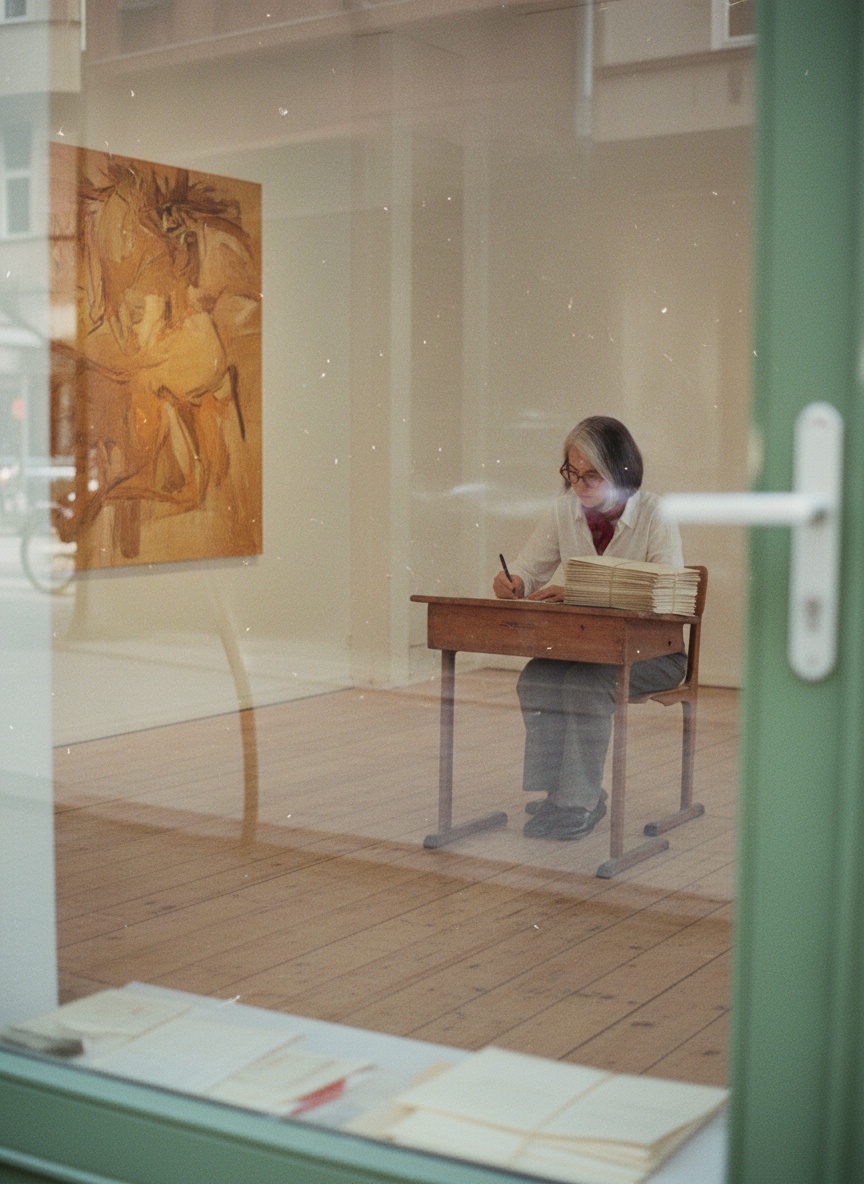
The door is locked at 3:10 on a Saturday afternoon. The light through the glass is the hazy, tired kind that makes a room look like a photograph of itself. At the back, Mei-Ling Ostrowski sits at a school desk with her back to the street. She is writing an address. She does not turn round when I knock.
Galerie Halbtag opens on Wednesdays and Fridays, from two until seven. That is the whole programme. Berlin has galleries that open by appointment and galleries that open when the owner feels like it. This one opens twice a week and has done so for eleven years. People have stopped asking why.
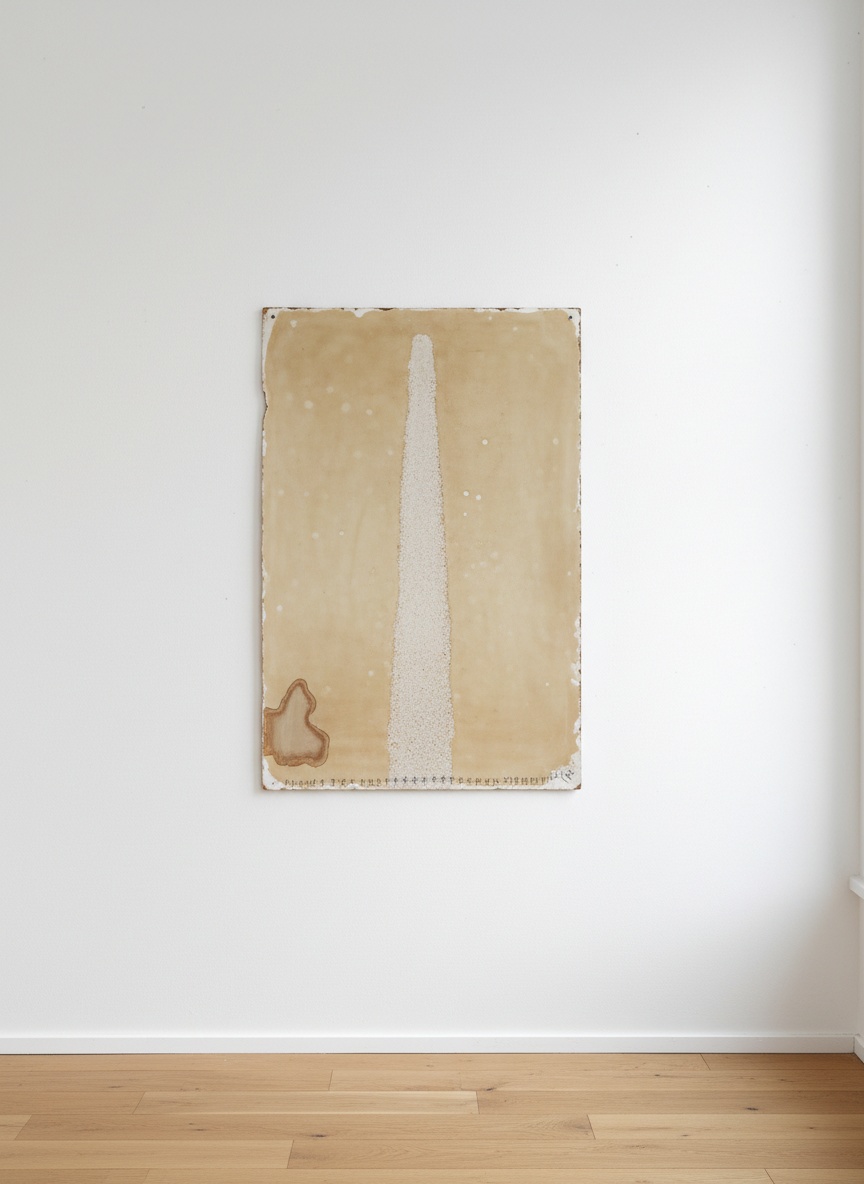
The show on the wall is by Dagny Pohl, a painter from Cottbus. The piece in the window is called Waiting Room Floor (Ochre). It is 120 by 80 centimetres, on a salvaged sheet of linoleum the colour of weak tea. Pohl has painted over it in thin oil, then rubbed a pale path down the middle with a sanding block, so the pattern underneath shows through like a trail worn by shoes. Pencil tally marks run along the lower edge, in fives, hundreds of them. In the bottom left corner, a brown stain of old tile glue has bled up through the paint. Pohl left it in. It looks like a map of a country that lost a war.
I come back on Sunday morning in my head, because on Saturday I can only look. The pile on the desk is a stack of cream envelopes, bound with a rubber band the colour of a rubber band. Mei-Ling tells me later, by telephone, that there are 140. Each is addressed in blue ink and each is stamped. They are invitations to Pohl's closing evening, which has no date yet.
"You cannot send an invitation to a day that does not exist," she says. "But you can have it ready."
I ask whether anyone has ever come on a Saturday. She thinks about it for a while. A man once stood outside for forty minutes, she says, reading the opening hours on the door, and then left without trying the handle. She watched him from the back of the room. She didn't wave. It seemed rude to interrupt someone who had read the sign so carefully.
The baker next door sells rolls seven days a week and has opinions about this. He says the gallery has the best door on the street. It is heavy and green, with a brass plate worn smooth by hands that never quite got in. He says he has seen people lean on it like a friend.
Mei-Ling's idea of a Saturday is not a day off. It is a day when the gallery is allowed to be a room again, with nobody being looked at in it. She writes addresses. She straightens the pencil tallies in her head. She lets the work do whatever work does when no one is watching.
Before I hang up I ask about the stamps. They carry a postage rate from three years ago. She says she knows. She will need to add a few cents to each one when the date comes. She has been meaning to buy the little top-up stamps for some time.