Right now, a magnifying glass hangs over a horse in Neukölln
In a fourth-floor flat, Baatar Enkhsaikhan checks a steppe that is 26 millimetres wide. He is looking for one cloud that is wrong.
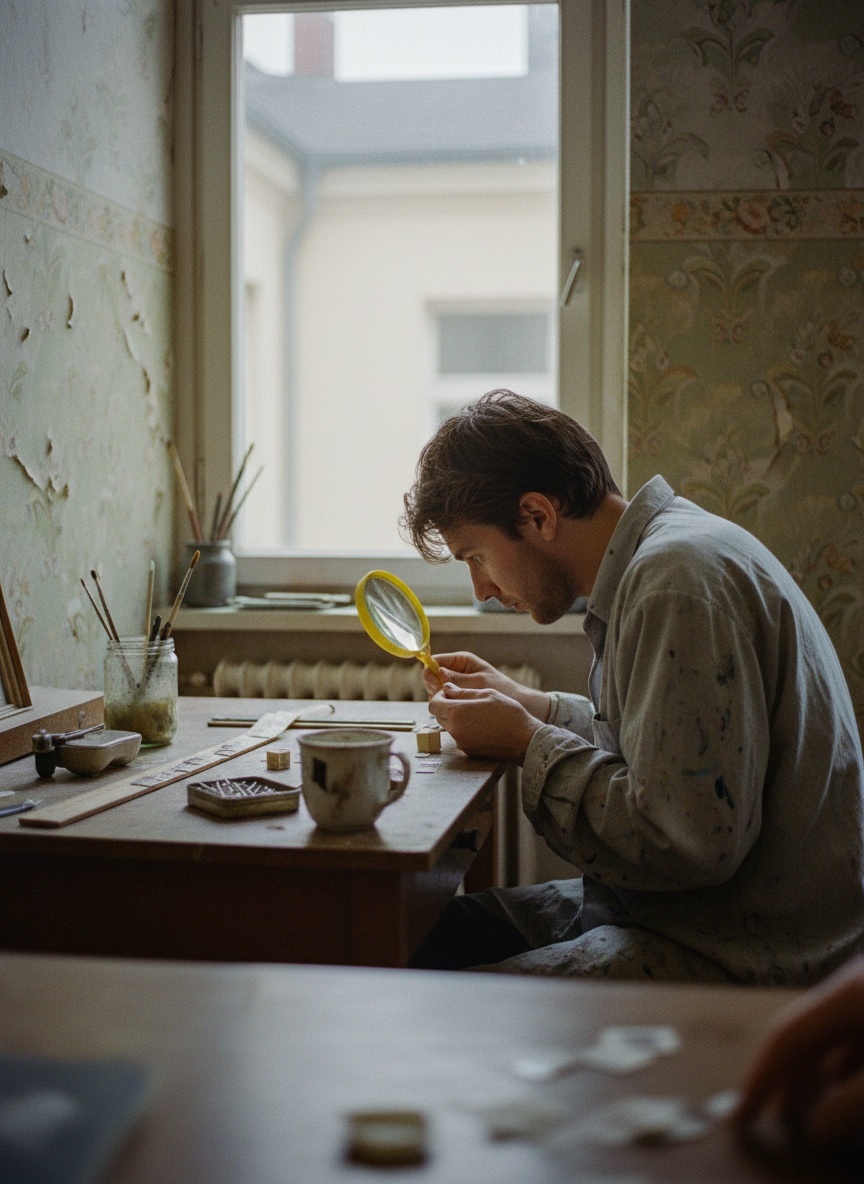
The magnifying glass is from a pharmacy. Round, yellow plastic rim, a scratch across the lower edge. Baatar Enkhsaikhan holds it eleven centimetres above the stamp and does not move.
It is 9:40 on a Friday morning. The window faces a courtyard and the sky is the colour of dishwater. Good light, he says. Nothing throws a shadow.
The stamp is cream, unused, perforated on all four sides. He buys them in bags of two hundred from a dealer in Wedding. Each one has a horizon, a band of cloud, and a long slope of yellow-green grass. In the lower left there is a ger the size of a grain of salt. A horse is two strokes.
He paints with a brush of three hairs. He cut them himself from a larger brush and tied them with thread. The handle is a matchstick.
On the desk there is a mug of cold tea, a ruler, a tin of pins, and eleven finished stamps lined up on a strip of tape. Each is a different hour. One is dusk. One is just after rain. One, he says, is Tuesday.
He leans in. The glass tilts. For almost a minute the only sound is the radiator.
Then he finds it. A cloud on the left edge, heavier than the others. It has weight where it should have distance. To anyone standing at arm's length it is invisible. To him it is a stone in a shoe.
He dips the brush into water, touches it to a rag and takes the cloud down by about a third of a hair. The whole operation takes four seconds. He checks again. Satisfied, he lays the stamp at the end of the row.
The flat is 41 square metres. He has lived here six years. The steppe on the desk is, by any measure that matters to him, larger.
Collectors ask how he decides when one is finished. He says the grass has to be able to move. He does not say how he knows.
The stamps sell for 90 euros each, in a matchbox, with a square of tissue. Buyers sometimes ask if they can post a letter with one. He tells them it would be a very long way to send a letter.
On the back there is still the original gum, pale and slightly shiny. He has never licked one. He turns the stamp over, looks at the gum through the glass for a moment, and puts it down.
"Where would it go," he says.