A Dying Cymbal Stand and a Reflective Coat With One Glove
In the room above the Feijenoord bakery, Sixes taped a stand giving up for 1.3 seconds, and Grim Foh turned it into the snare of a track that runs at 91 BPM.
The stand goes at 7.42. You hear the ratchet first: tk, tk, tk, three teeth of the tilter letting go. Then a squeal somewhere around three kilohertz as the boom sags. Then the cymbal slides down the tube and lands on the base with a flat, bright clank that does not ring. It lasts 1.3 seconds. Sixes is crouched next to it with a handheld cassette recorder, and he does not move until the tape stops.
"Again," he says.
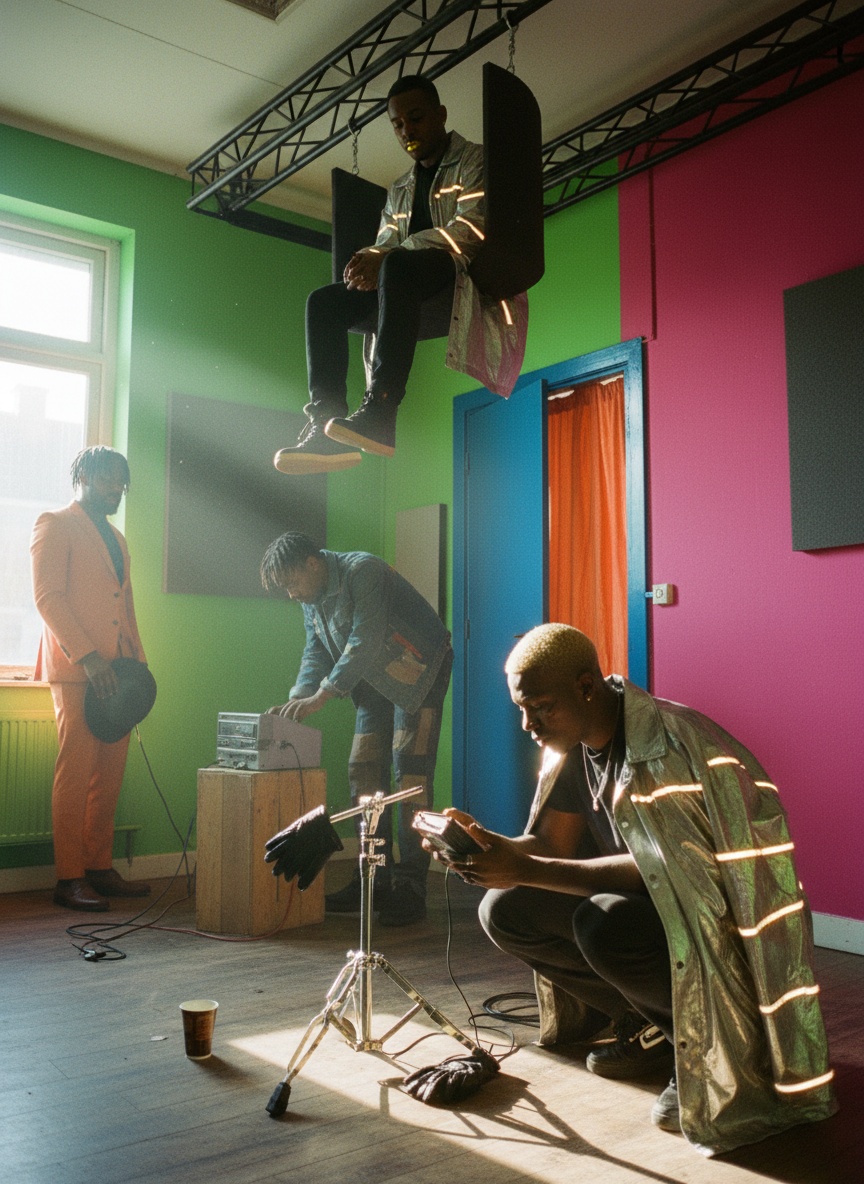
This is a Sunday in Feijenoord, early, with the sun coming in low over the bakery roofs. The rehearsal room is painted acid green on three walls and hot pink on the fourth, with a cobalt door and an orange curtain that has never once been closed. The light hits the pink wall and the whole room goes the colour of the inside of a mouth. On the floor lies a cymbal stand with a stripped wing nut. A thick bead of gaffer tape holds the boom on. It is dying very well.
Hanging from the stand's other arm is Hex's coat. It is a reflective coat, the silver kind that turns white under a camera flash, and the low sun turns it into a mirror. Bars of light swing across the green wall every time someone walks past. One glove is pulled over the tip of the boom, a black leather one, fingers up. The other glove is not in the room. Nobody says where it is.
"It's with the first glove's family," Hex says. He says this very seriously. Lull sewed the coat, left sleeve last, and she says the missing glove was never part of the design. "The one glove is correct. Two gloves is a costume."
Back to the stand. Sixes has done eleven takes by 8.10, and each one fails differently. Take four sags slowly and gives you a long groan. Take seven snaps early and throws the clank off the beat. Take nine is the one. The ratchet clicks come in tight, the squeal peaks and falls in under half a second, and the clank lands dry, with almost no tail, because the room is small and the foam on the walls drinks everything. I heard it in about two seconds and I wanted to hear it again immediately, which is the test.
What happens next takes Cathedral four minutes. He loads the tape into the cassette four-track and drags the pitch down with his thumb on the speed dial until the squeal drops from a whine to a growl. The clank gets heavier and starts to sound like a door in a very large building. He trims the whole event to 1.32 seconds. That is exactly two beats at 91 BPM. The track is not the tram bell track, which sits at 84 and lives somewhere else in the set. This is the next one, slower in feel and faster in number, and it has a snare that sounds like a machine being told no.
Then the layering. Sixes hits the oil drum lid welded to the bicycle stand, one crack on two and four, and Cathedral lays the stand failure under it so the crack arrives with its own collapse attached. The drum lid supplies the front edge, a hard tick around 2 kHz. The stand supplies the body and the sag. Together it is a snare with a past. You hear a hit and you hear something giving way behind it, and your neck decides it likes that before you do.
The bass is a single note, an E-flat, dragged through the slowed tape so it wobbles about a quarter tone flat. Cathedral says the wobble is the tape and not a choice. "I would never choose it," he says. "I would also never fix it." Over the top there is nothing yet, just the snare and the E-flat, and the loop is already doing that rare thing where it feels finished and unfinished at the same time.
Lull is on the lighting rig. She went up at 8.30 with a dynamic mic in a foam sock and a length of sash cord, five metres above the floor, and she is sitting on the truss with her boots swinging over the cymbal stand. The sun reaches her last. When it does, the silver coat throws a bright patch up onto her face and she squints into it and keeps writing. She records her first pass without being asked, one take, flat on the beat, a low line about stairs. From above, the words arrive slightly late and slightly cold, which is how everything she records arrives.
"What does Foh mean," I ask, because everyone does.
"The stand," says Cathedral, without looking up.
"The coat," says Hex.
"The stairs," says Lull, from the ceiling.
Sixes thinks about it with the recorder still in his hand. "The 1.3 seconds," he says. Nobody argues, which is unusual, and then Hex says it is also all of those, and the room agrees in a way that sounds a lot like the snare: sudden, a bit wrong, impossible to unhear.
Downstairs the bakery has been selling rye since six. The smell comes up through the floorboards and mixes with hot dust and cold tape. Somebody has propped the stand against the pink wall like a patient. The boom is held up now by an elastic hair tie and a prayer, and Sixes taps it twice with a knuckle to see if it has anything left. It gives one last tk. He presses record.