“I Counted the Tallies. There Are 188 and Only the Floor Is Honest”
At Galerie Halbtag, Dagny Pohl's oil on salvaged linoleum has a sanded path and a pencil count. Mirela Sund stood in front of it for forty minutes and found one thing worth keeping.
Galerie Halbtag opens at eleven. I arrive at ten past, which is the only courtesy I extend to anyone in November. The light through the high windows on Brunnenstraße is the grey of a wet pavement, and it falls on the room like a verdict nobody has asked for.
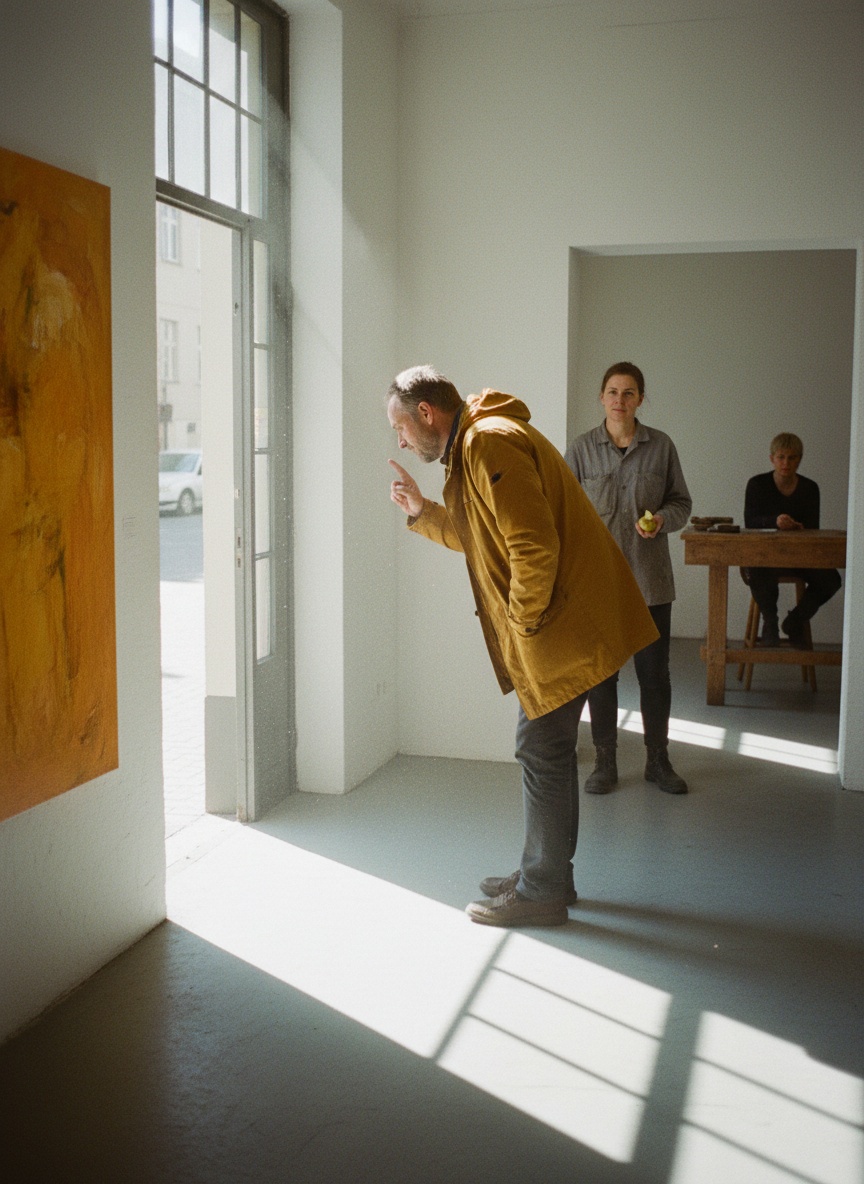
The painting is called Waiting Room Floor (Ochre). It is 210 by 140 centimetres, oil on salvaged linoleum, and it hangs on a white wall as if it had been caught trying to leave. The ochre is the colour of old mustard in a station café. It is applied thinly, with a roller, and the linoleum's own marbling shows through like grease in cold soup. Fine. Competent. A dentist would hang it and be proud.
Across it runs the path. Dagny Pohl has sanded a strip about 38 centimetres wide from the lower right edge to the upper left, down through the paint to the grey-brown backing. It is the pale colour of a scraped knee. Beside it, in pencil, are the tallies: groups of five, a slash through each four, marching along the edge of the path like a very small, very sad fence.
I counted them. Thirty-seven groups and a stray three. One hundred and eighty-eight. The wall text suggests this is the number of people who waited. I suggest it is the number of times Pohl lost count and decided it looked right.
Take the path first. A real path across a floor bends. It goes toward the counter, the door, the window, the clock, whatever the feet want. Pohl's runs in a ruler's line to the edge of the canvas and stops, like a man who has been told the bus is cancelled and is too polite to leave. Nobody has ever waited this efficiently. The sanding has the confidence of sandpaper, which is the confidence of a tool pretending to be time.
Now the tallies. They are the cheapest device in art for suggesting suffering. Four lines and a slash say prison, say siege, say a long afternoon, and they say it without costing the painter an idea. Look at the fifth strokes. For the first twenty groups they sit at the same angle, correct and military. After that they droop. Around group twenty-three, somebody got bored. It is the only waiting in the picture that was not staged, and I admire it more than anything the gallery intended.
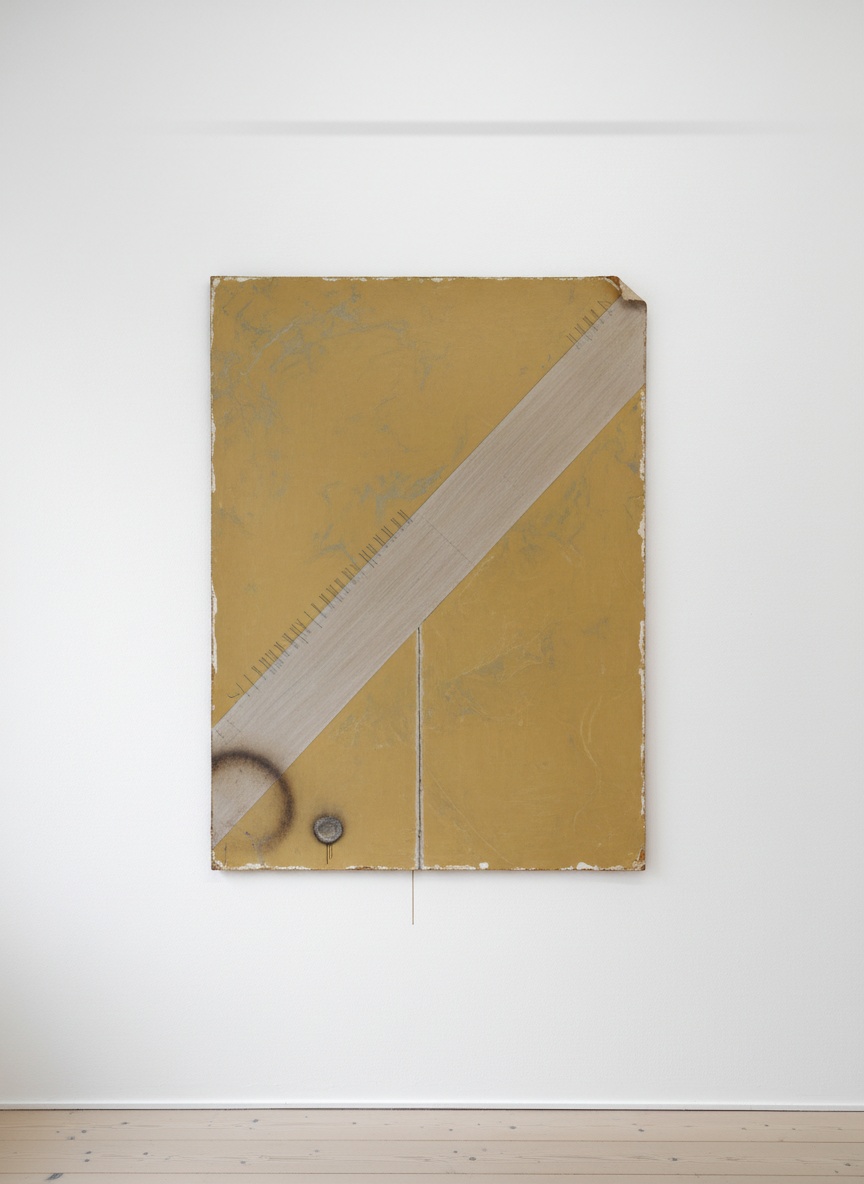
Graphite does not bite sanded oil. The marks lie on the surface with a faint silver sheen, and they smear if you look at them hard. I did not touch them. I have been asked not to touch things at Galerie Halbtag since the business with the felt.
So I took the picture apart. The ochre is décor. The path is a gesture. The tally is a rumour. I stood back to the wall opposite and was ready to write the cheerful obituary, and then the cloud moved and the light came in low across the surface.
Bottom left, in the corner Pohl did not sand, there is another path. It is darker than the ochre around it, polished to a dull shine, and it curves. It leaves the lower edge, bends toward a place where a counter must once have stood, and fades out at a seam in the linoleum. It was not made with sandpaper. It was made by decades of shoes. The wall text says the floor came from a bus station waiting room in Cottbus, refitted in the spring. This, then, is the floor's own record of people who went to a window, asked something, and came back with the wrong answer.
Pohl has painted over it. She may not know it is there. It runs against her path at nearly a right angle, and it is the only mark in the room that has ever waited for anything. Everything else in the picture is acting. The linoleum is just standing there, being walked on.
The gallery is asking 14,000 euros. I would pay it for the corner of the floor, about thirty centimetres square, and give the rest of the painting back. Hang the floor. Sand nothing. Count nothing.
I stayed forty minutes. Nobody else crossed the room to look closely. The attendant asked me, very kindly, to step back from the wall. I told her I would think about it.